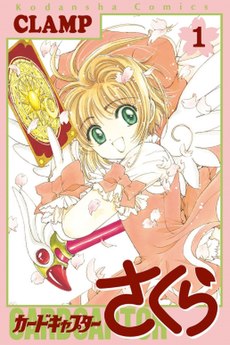
Cardcaptor Sakura (カードキャプターさくら, Kādokyaputā Sakura?), also known as Cardcaptors and abbreviated as CCS, is a Japanese manga series written and illustrated by CLAMP. Cardcaptor Sakura is published in Japan by Kodansha and was serialized in Nakayoshi. The series consists of twelve volumes. The manga is well-known for its emphasis on the shōjo genre of the series; nearly every page has detailed flowers, bubbles, or sparkles around the main characters. It won the noted Seiun Award for best manga in 2001.
The anime television series (1998-2000) based on the manga consists of 70 half-hour episodes (spread over three seasons), two theatrically released movies, and several specials. The second season of TV series won the Animage Anime Grand Prix prize in 1999. Nelvana produced an English dub of the anime series, titled Cardcaptors, which aired in English-speaking countries.[1] An unedited English translation, bearing the original title, Cardcaptor Sakura, was broadcast in its English-language networks by the anime television network Animax. Cardcaptor Sakura has also been released in North America on unedited and subtitled DVDs.
Several characters from Cardcaptor Sakura are reworked for use in another Clamp series, Tsubasa: Reservoir Chronicle. These characters share similar appearances and traits to their Cardcaptor Sakura inspirations, but they are not the same characters, rather alternate universe versions.
Ten-year-old fourth grader Sakura Kinomoto opens a mysterious book in her father's study and accidentally releases the magical Clow Cards. Created by the half-English half-Chinese sorcerer Clow Reed, the Clow Cards were sealed within the Clow Book upon his death and represent a combination of magic from Clow's mixed heritage. Each card has its own personality and characteristics and can assume alternate forms when activated.

Cerberus, the guardian Beast of the Seal, awakens and emerges from the book's cover. Upon learning the cards are gone, he tells Sakura that she must have special powers, and that is now her responsibility to retrieve the missing cards. As she finds the cards, she must battle its magical personification and defeat it in order to seal it away. Cerberus acts as her guide and mentor throughout the quest, while her classmate and best friend Tomoyo Daidouji films her exploits and provides her with costumes, insisting that she must "wear special clothes for special occasions." Her older brother Toya Kinomoto watches over his sister while pretending that he is unaware of what is going on.
As the series progresses, a rival in the form of Syaoran Li appears. A descendant of the late Clow Reed, creator of the Clow Cards' and their guardians, Syaoran travels to Japan from Hong Kong to recapture the cards, but finds his goal complicated as he comes to respect Sakura and begins aiding her instead. Once Sakura has captured all of the cards, she must undergo the Final Judgement. Yukito Tsukishiro, Sakura's crush and the best friend of her brother, is revealed to be the false form of the card's second guardian Yue, who tests Sakura to determine if she is worthy of becoming the card's true master. Sakura is aided in the test by Kaho Mizuki, who is later revealed to have been sent by Clow to ensure Sakura is able to pass the test because he choose Sakura to be the new card's master when he knew he was going to die.

With Sakura as the new master of the Clow Cards, life initially is peaceful until the arrival of a new transfer student from England, Eriol Hiiragizawa, which coincides with new disturbances occurring in Tomoeda. Yue and Cerberus find themselves unable to aid Sakura during a magical attack, and Sakura is unable to use the Clow Cards. Sakura transforms her wand and creates a new activation spell for it, enabling her to then transform one of the Clow Cards into a Sakura Card. As the series progresses, she continues finding herself in situations which cause her to have to transfer the cards, unaware they are being caused by Eriol and two guardian-like creatures, Spinel Sun and Ruby Moon. Yue, who requires the support of another to generate his own energies, begins growing weaker as time passes, though he initially does not tell Sakura that it is because her magic is not yet strong enough. The problem does not effect Cerberus whose power, like the sun, regenerates on its own with no need to draw extra power from other sources.
During these events, Sakura finds herself having to deal with the pain of Yukito's gentle rejection of her feelings, as he instead loves her brother Toya. Toya, in turn, gives all of his magical abilities to Yue in order to ensure Yukito doesn't fade away, making Yue promise to protect Sakura in his place as his loss of powers prevents him from knowing when she may be in trouble. Syaoran helps her recover from the hurt, while finding himself falling in love with Sakura but unsure of how to tell her.
When there are only two cards left to be transformed, the Dark and Light which must be converted together, Eriol reveals himself to Sakura. Once she has successfully transformed the cards, he explains that he is half of the reincarnation of Clow Reed, with her father being the other half. Eriol has all of the memories and magic, enabling him to assist Sakura in converting the cards so that they would not lose their magical powers. With the task done, he asks Sakura to split his magic between himself and her father, so that he will no longer be the most powerful magician in the world. He then returns to England.

In the aftermath, Syaoran confesses his love for her, but Sakura is unsure how to respond. When he tells her that he is returning to Hong Kong, Sakura finds herself hurting and upset. After running into several of her friends, she realizes that it is because she loves Syaoran too. She rushes to the airport to tell him and he promises to return when he has taken care of some things. At the end of the series, he meets Sakura a year later having moved to Tomoeda permanently.
In the anime adaptation of the series, there are 52 cards to capture instead of the 19 seen in the manga, and in the second anime film, Sakura creates a card of her own, "The Hope." Some of the circumstances around the capturing of the cards seen in both media are changed. Syaoran's role is expanded some, with his capturing several cards and being tested by Yue before Sakura's test. An additional character, Meiling Li is introduced as Syaoran's cousin and fiancee, positioning her as a romantic rival for Sakura later in the series. The ending is modified some, with Sakura's father role as the second half of Clow Reed's reincarnation removed, as well as the splitting of Eriol's magic. The anime television series leaves the relationship between Sakura and Syaoran unresolved, with Sakura having not responded to Syaoran's love confession. Instead, the second anime film has Sakura attempting to confess throughout the film, but being unsuccessful until the end of the film.(wikipedia)
 Cardcaptor Sakura Japanese Manga Series
 Cardcaptor Sakura Manga